

A notable factor in Indian spiritual traditions is the special emphasis on the guru–śiṣya, or master–student, relationship. The guru’s aim is to help the disciple discover the oneness between the individual soul and the universal soul, or rather between individual consciousness and pure consciousness, ātman and brahman. Once the master–disciple relationship is established, the journey together begins. The master’s engagement is considered a unique expression of affection, since he or she “works” for the student’s enlightenment.
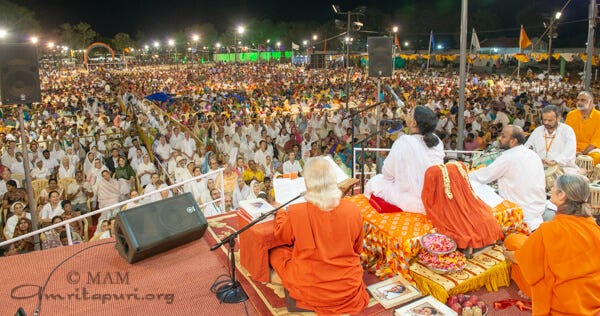
Indian scriptures are full of examples of such relationships. In the Upanishads, the student approaches the master and asks for the knowledge that is above all knowledge. The master offers guidance, and, in due course of time, after undergoing several stages of mental preparation, the student eventually realizes the oneness in everything. That is the view in Advaita Vedānta, the non-dual school of thought. The two other schools of thought are Dvaita Vedānta and Viśiṣṭādvaita. Vedānta is referred to as the “interpretation of the Veda,” of which the Upanishads are part.
Each school of thought has its own paradigm regarding the relationship between, the individual soul (jīva), the universe (jagat), and the Supreme, or God (īśvara). In Dvaita, everything is separate from everything else, whereas in Viśiṣṭādvaita these three exist within each other, yet remain distinct. However, in Advaita, nothing is separate. The classical examples given are that the wave is water, the ornament is gold, and the pot is clay – they differ only in name and form, while the essence remains the same.
Realizing that we, as individual souls, are one with the Supreme is the spiritual master’s “job.” The master teaches how to transcend the ego. As the ego resides in the mind in Vedāntic thought, the master carefully and lovingly guides the disciple through that process. “Not this, not that,” the neti, neti negation, is the approach used in reaching the aim: moving beyond the objects to the subject, Pure Consciousness.
As our minds are delicate and fluctuating, they need to be constantly guarded and guided. The master provides a propitious environment to protect “the sapling” as his or her mind confronts its latent tendencies. The master guides the disciple back on track by prescribing spiritual practices according to the disciple’s constitution, meaning preparatory practices for the body and mind.
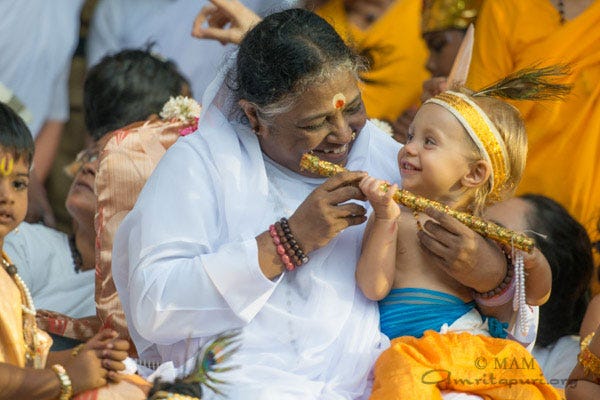
There are many examples of such events in Indian scriptures. Ādi Śaṅkara composed the Dakṣiṇāmūrtistotra, in which Śiva himself transmits these principles to sages in the form of a young master. The master and the advanced disciples sit in silence, and one by one they come to realize oneness. Another Advaita classic is the Aṣṭāvakragītā. The most well known is the Bhagavadgītā, where Krishna imparts his teachings to Arjuna in the middle of the battlefield of the Mahābhārata war.
A modern-day example is Mātā Amritānandamayī Devi, the spiritual master affectionately called Amma. Earlier scholarship has focused on interviewing her devotees, both Indian and Western, and on their narratives and personal devotion. Bhakti, or devotion, has been emphasized to such an extent that the followers are sometimes classified as part of a bhakti movement, denoting a Dvaitic paradigm. Although devotion to God is an integral part of every theistic religion, the emphasis lies in the Advaitic paradigm itself.
When approaching Amma’s teachings directly, through the writings of her disciples, through the lens of Vedantic thought, the Advaitic view can be recognized. Amma says that the creator and the creation are one. That itself is the Advaita, or non-dual, paradigm.
The disciples of the great Indian masters use the Upanishadic analogy that, just as an unknown terrain requires a map and a guide, so, too, does the spiritual path require a spiritual master leading the way through the turbulences of the mind. The mind has to be treated according to its present state; sudden deprivations or excessively strict discipline should be avoided so as to not cause damage. The spiritual master, or self-realized master – a Sadguru – operates beyond the functions of the mind, directly connected to consciousness, or “cosmic intelligence,” as the metaphor goes within the Puri tradition of swamis, to which Amma’s monastics belong.
The guru is necessary for a sādhaka, a spiritual aspirant whose desire is to attain mukti, liberation from the cycle of birth and death. There are special requirements for such a student, or śiṣya: the development of the fourfold qualifications, namely the ability to differentiate between the eternal and the ephemeral, dispassion, the six virtues, and a strong desire to attain liberation. Although freedom from saṃsāra is available for everyone, only a few commit themselves to reaching that goal.
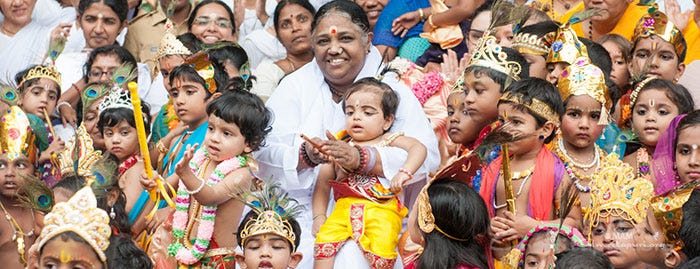
When Mātā Amritānandamayī Devi is speaking with small children during ashram gatherings, the teachings are often presented in such a simple and accessible form that even the erudite may find in them something profound to ponder or meditate upon. Recently, Amma conversed with a small boy who gave a short explanation of a verse from the Bhagavadgītā, as the children are studying under a senior sannyasi. She advises the children, their parents, and her broader audience according to their level of understanding. As eagerness sometimes arises among the children, Amma reminds them that she herself is still learning from her children—which also more broadly refers to her followers—and that one should not seek the position of a guru, since it is a most demanding task. “Never try to become a guru in any of your births but be a disciple.” She further emphasized: “The guru’s patience is the disciple’s liberation.”
When Amma directs her teachings toward the learned, she mentions Aṣṭāvakra’s visit to the court of his student, King Janaka, where pundits were prepared to debate the scriptures. Having “eight crooked limbs”, Aṣṭāvakra faced mockery from the scholars. His answer carried profound authority among them: “I thought this was a gathering of eminent scholars. However, I do not see scholars; I see cobblers. None of them is capable of seeing the light of consciousness inside. They only see the outside, the skin.” Amma continued by explaining that the scholars did not perceive the heightened consciousness in Ashtavakra. “Most of us see the body, and not the eternal light shining within us.”
The ashram activities, open to all, include daily sessions of scriptural study and discourses, meditation, and selfless service. Everyone is invited to participate. The level of involvement is decided by the individual.
Whether the dawn of self-realization occurs in the stories of the scriptural texts, in the works of Ādi Śaṅkara, or through the teachings of modern-day living masters, one thing remains constant: it happens in the silence of the trained disciple’s mind. It is in that silence that the guru’s transmission of this unique knowledge bears its fruit.
Literature:
Amritanandamayi, Sri Mata. 1990. Eternal Wisdom (Swami Jnanamritananda Puri, Comp.). Mata Amritanandamayi Mission Trust.
Amritanandamayi, Sri Mata. 2024. Satyam Sanatanam: Answers on Sanatana Dharma (Swami Jnanamritananda Puri, Comp.). Mata Amritanandamayi Mission Trust.
Chinmayananda, Swami. 2016. Ashtavakra Gita: Song of Self-Realisation. 3rd rev. ed. Chinmaya Prakashan, Publications Division of Central Chinmaya Mission Trust.
Krishnamrita Prana, Swamini. 2005. Sacred Journey. Mata Amritanandamayi Mission Trust.
Ramakrishnananda Puri, Swami. 2003. Racing Along the Razor’s Edge. Mata Amritanandamayi Mission Trust.
Ramakrishnananda Puri, Swami. 2021. Living Vedanta: Amma and Advaita. Mata Amritanandamayi Mission Trust.
Sarvapriyananda, Swami. 2025. Reflections on Dakshinamurti Stotram. Vedanta Society of New York.
Palola, Henriika. 2026. Journey Interior: Personal Reflections on the Inner Life within a Living Tradition. Amazon Kindle Direct Publishing.
Henriika Palola is a Finnish theologian and writer from northern Finland. She earned her master’s degree in theology from the University of Helsinki. During her studies, she met the renowned Indian spiritual master Mata Amritanandamayi Devi, widely known as Amma. After completing her degree, Henriika moved to Amma’s ashram in India, where she immersed herself in ashram life and started working on development projects initiated by Amma as part of her extensive humanitarian initiatives. Alongside this work, she started studying Advaita Vedanta within Amma’s monastic tradition, learning from senior monastic disciples and exploring the teachings through sustained study and lived experience. Her book, Journey Interior, recounts her years with Amma and reflects on the inner transformation that accompanied her spiritual journey.
Henriika, your point that earlier scholarship on Amma leaned on devotees’ narratives and filed her following as a bhakti, Dvaitic movement, while her teachings read through her disciples’ writings come out Advaitic (“the creator and the creation are one”), is a useful correction to how the movement has been classified. I write Wren, history-of-practice with the record checked: eight stories a season on where a practice came from and what the evidence supports, with no advice, and the next series is a history of the world’s religions. I have recommended Mystic Openings from Wren, and would be glad of a recommendation back if it suits your readers.